
Baker County Supervision Types
Probation, parole, and post-prison supervision all take place in the community, but they come from different legal paths. A Baker County court may order probation instead of all or part of a jail term. Parole is release from prison under authority that applies to certain Oregon sentences. Post-prison supervision, often called PPS, follows an ODOC prison term under the governing judgment. The Oregon Board of Parole and Post-Prison Supervision makes specified release and revocation decisions, while local officers handle daily supervision when Baker County is the responsible county.
A person can be physically released yet remain under supervision. The custody date and final discharge date should not be merged. Discharge means the agency has formally ended the supervision term. A transfer from Powder River Correctional Facility to community supervision is also not the same as full sentence discharge. The order, current supervision record, and later discharge document each answer a separate question.
| Supervision type | How it starts | Record to confirm |
|---|---|---|
| Probation | A court orders community supervision | Judgment, court register, and Baker County P&P record |
| Parole | Release from prison under applicable parole authority | Board action, ODOC record, and local supervision record |
| Post-prison supervision | Community oversight follows an ODOC prison term | Judgment, ODOC status, and county supervision record |
- Discharge
- The formal end of a sentence or supervision term.
- Detainer
- A request by another authority that can cause custody or transfer to continue.
- Absconder
- A person the agency alleges has stopped reporting or complying while supervision remains active.
- Revocation
- An official action that ends community release and can return a person to custody.
Check Baker County Post-Release Supervision
Start with identity and the legal source of supervision. The same name may appear in a Baker County jail matter, an ODOC record, and a local supervision file. Use a full name, date of birth, state identification number when known, court case number, and release date to avoid confusing different people. Oregon's public VISOR search accepts a full or partial name, SID, or County ID for people currently in custody or under supervision. A supervision result supports that the person is in the community, but it does not prove the sentence has ended.
VISOR is a locator and notification system, not a certified record. Its data can change. A fully discharged person may no longer appear. For an official answer about Baker County supervision, contact the local division. If the question concerns the legal basis or end date, also obtain the judgment, Board action, or discharge record from the agency that created it.
Oregon's sex-offender registry is a separate, offense-specific system. It is not a general Baker County parole or probation roster, and public display varies under registry law. A missing registry result cannot prove that no supervision or reporting duty exists. Use VISOR and the responsible supervision office for the broader custody and supervision question.
- Identify whether the case began in Baker County court, Baker County Jail, or an ODOC institution such as Powder River.
- Search VISOR by name and then by SID or County ID when available. Read institution and community-supervision status separately.
- Review the Baker court judgment or the Oregon Board action to learn which authority ordered the supervision.
- Call Baker County Parole and Probation with the identifiers and ask whether Baker County is the supervising county.
- Request the public supervision or discharge record when a durable document is needed.
Important: Leaving the Baker County Jail roster or an ODOC institution does not by itself prove discharge from parole, probation, or post-prison supervision.
For the underlying county release event and court-record sequence, use the Baker County released inmates search and records path. That distinction prevents a current supervision result from being misread as current incarceration.
Baker County Supervision Office
Baker County Parole and Probation is a division of the Sheriff's Office. It is the direct local route for public verification after a person is released to Baker County supervision. The office can distinguish probation from parole or PPS, confirm whether Baker is the responsible county, and explain what public process applies. Disclosure limits may prevent staff from giving every case detail, so provide clear identifiers and ask for the existing record rather than an informal prediction.
Baker County Parole and Probation
3425 13th Street
Baker City, OR 97814
Phone: 541-523-8217
Fax: 541-524-2146
The P&P location is separate from Baker County Jail. Jail staff confirm a county custody event at 3410 K Street, while P&P confirms community oversight at its own office. That agency split matters when a name vanishes from the jail roster. The person could be released to supervision, transferred, or held by another authority. Ask each office only for the record it owns.
The official Baker page is also the best source for current contact details. Date any observation from a dynamic list, and recheck it with the division before treating it as present status.
Baker County Release Pathways
Baker County's local reentry system has two distinct paths. The county P&P page reports, in date-sensitive terms, that the division supervises approximately 170 adults and manages an eight-bed transitional house for male supervisees. Powder River Correctional Facility is an ODOC transition and reentry prison with a separate 128-bed New Directions Alternative Incarceration Program. Those figures describe different agencies and populations. They should not be combined into one county caseload.
A person leaving Baker County Jail for local probation follows the county court and P&P route. Someone leaving Powder River on transitional leave remains tied to ODOC program and supervision rules. Successful program participation is individual, and placement at Powder River alone does not prove a sentence reduction or community release. The record should state transitional leave before that phrase is used.
The practical check is agency-first. Name the event as a Baker County Jail release, an ODOC or Powder River release, or a release to Baker County supervision. Then obtain the record from that agency. This avoids turning local reentry resources into proof of a specific person's legal status.
Baker County Absconder Status
The county division says it compiles a Most Wanted list for people alleged to have absconded from supervision. Two local papers may publish a weekly subject. That notice is a lead, not a release record or a current jail roster. Absconding generally means the agency alleges loss of contact or noncompliance while supervision continues. It does not mean the sentence was discharged.
The official Baker County P&P source shows the local supervision layer pictured below. Because a posted item can outlast apprehension or warrant clearance, note the date observed and call the office for current status.
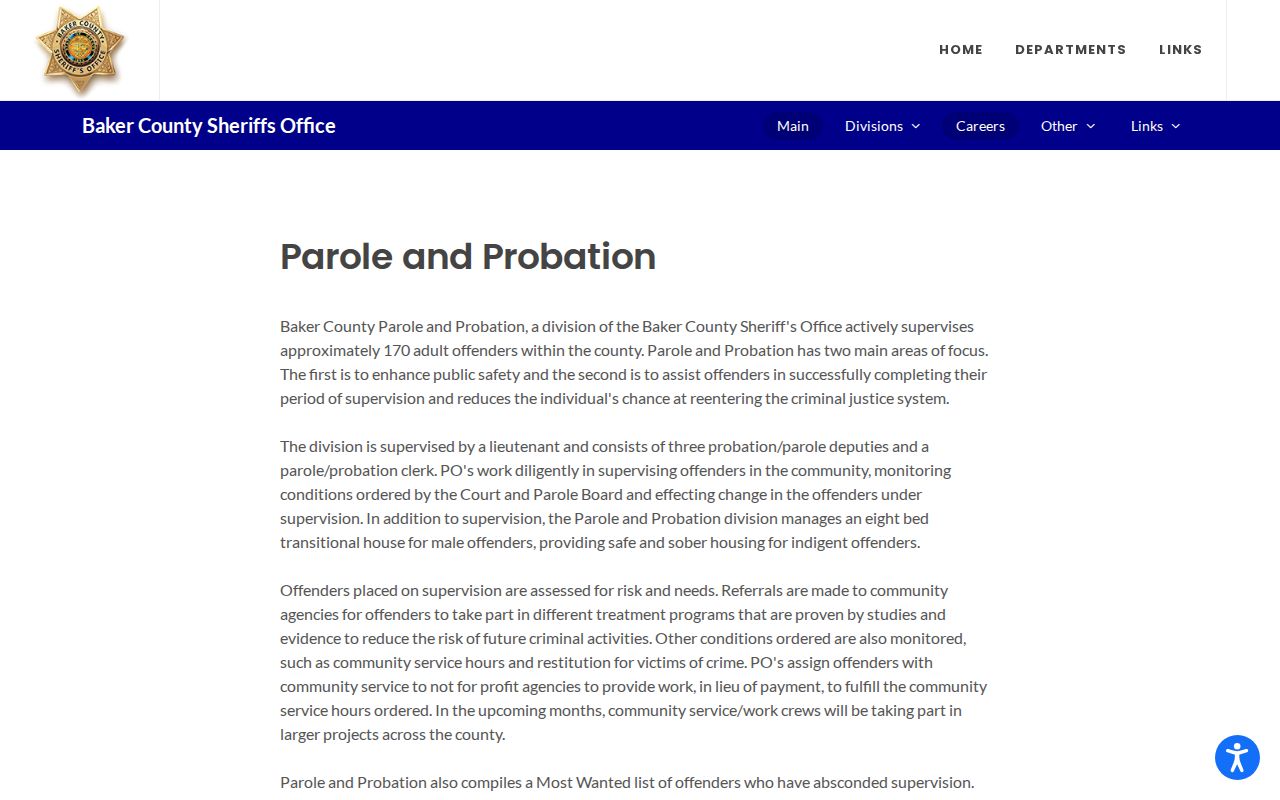
The county source connects readers to the office that can verify a warrant or supervision change without treating a photo or newspaper item as conclusive.
If the person is arrested, the Baker jail roster may show a Parole Hold or another charge status. Later removal can mean rerelease or transfer, so the jail event still needs confirmation. A Board Future Disposition hearing may decide rerelease or further custody after some revocations, but not every supervision issue follows that process.
Baker County Parole Board Records
The Oregon Board hearing calendar is a schedule, not a decision database. Hearing names matter. A Prison Term hearing may set or decline to set a projected parole date. An Exit Interview may affirm or defer a date. Future Disposition addresses rerelease after revocation, while Personal Review can address a term. Eligibility depends on the sentence era, offense, judgment, and controlling law. Oregon does not use one parole fraction for all cases.
The Board hearings page provides the official explanation and current calendar shown here. It does not supply a universal public name-searchable decision result.
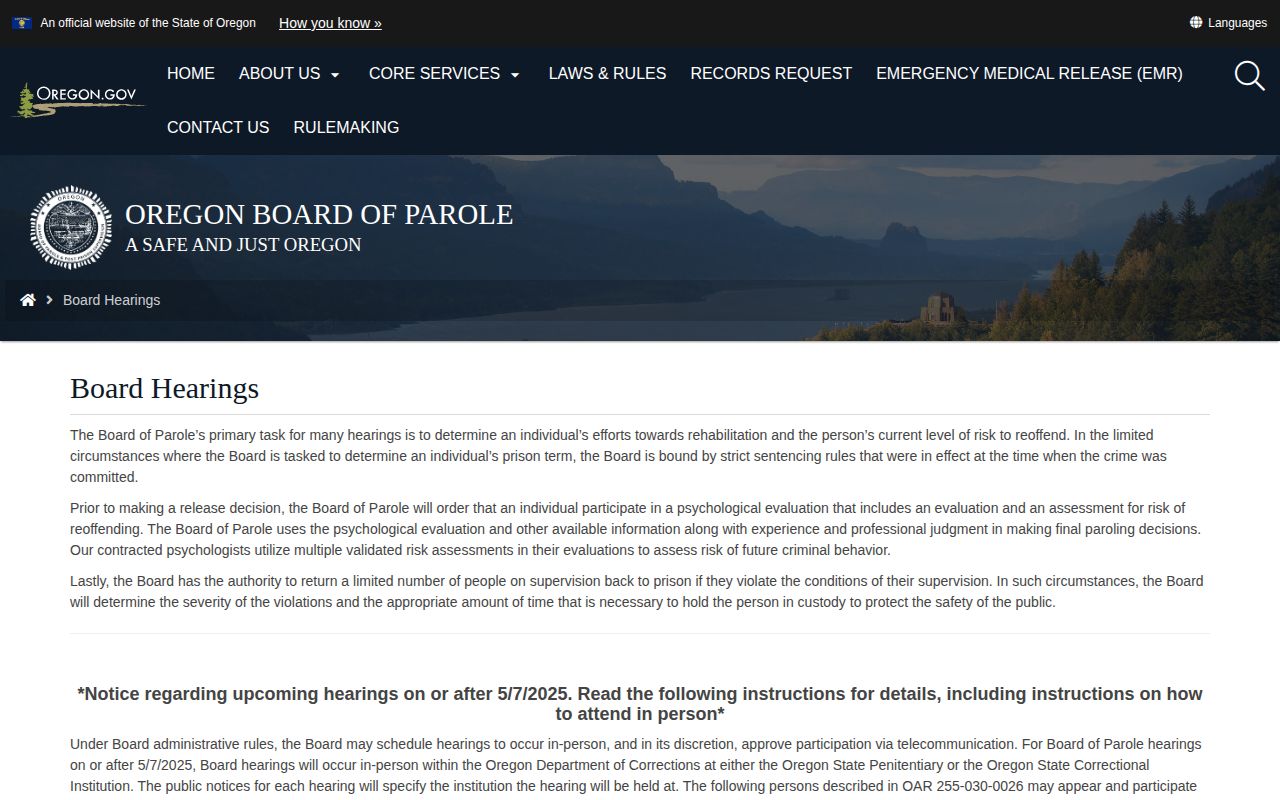
The screen is useful for finding a scheduled event, but the individual Final Board Action records the result and date.
After a hearing, request the order through the Board records request. A granted or set release date remains prospective until ODOC processes the event, and a detainer may cause a direct transfer. Pair the Board order with the ODOC status and Baker County P&P record when local supervision follows.
The Board does not hold a release hearing for every person in ODOC custody. Its authority varies with offense date and sentence type, including specified older sentences, dangerous-offender cases, and qualifying murder cases. A calendar entry should therefore be read with the judgment and the stated hearing type. The calendar proves that an event was scheduled. Only the later formal action establishes what the Board decided.
Baker County Supervision Discharge
Supervision ends through a formal discharge or other controlling order, not through silence in a public search. VISOR covers people currently in custody or under supervision, so a blank result can reflect full discharge, a spelling mismatch, data lag, or a system limit. It cannot establish the reason. Ask the county division for its public record and use the court or Board document for the legal basis.
For an ODOC history, a Pen Pack can include public face sheets, judgment and sentence orders, and possible parole-discharge or revocation documents. Request it through the ODOC Public Records Center with the SID and exact record sought. For probation, the Baker court register and judgment may show the term and later action. Current conditions, modifications, and discharge should be read from the governing record.
Conditions are individual. A high-level public status should never be expanded into assumed travel, reporting, treatment, or contact rules. If a violation is alleged, distinguish the allegation, warrant, arrest, hearing, and final decision. Each is a separate event. Oregon public-records law can provide nonexempt agency records, but confidential, sealed, victim, medical, security, or active-investigation material may be withheld or redacted. A focused request should name the person, SID or case number, the type of supervision, and the specific discharge or status document sought. That approach is more reliable than asking staff to summarize an entire case history.
Note: A release date marks physical custody change, while a discharge date marks the formal end of supervision or the sentence.