
Baker County 72-Hour Release Status
No separate Baker County 72-hour release selector, historical release page, or downloadable three-day archive was found in the official Sheriff navigation and linked JusticeConnect interface as of August 1, 2026. The public page is labeled Jail Roster. It shows a current population view with scheduled information, not a record of all completed departures over the prior three calendar days.
A wider lookback should therefore be built from agency records, not from names that disappear between saved screens. Snapshot comparison can misclassify a transfer, a data correction, or a person held by another authority as community release. It can also expose personal information without establishing the event. The sound question is whether Baker County maintains an existing release-event record or list responsive to the chosen dates.
Important: A three-day court search and a three-day roster comparison are not substitutes for Baker County Jail's actual release events.
Check Baker County Three-Day Releases
Set the requested period with exact start and end dates. For a local jail case, the Baker County Sheriff's Office owns the booking and custody-status event. The court owns the judgment, release agreement, and case register. Those records complement one another. A court disposition may explain why custody should end, while the jail record shows whether and when the person physically departed or moved to another authority.
- Choose the precise three-day period and record the local date boundaries used.
- Check the live Baker roster for current display and docket clues, not for historical release totals.
- Ask the jail at 541-523-8011 about a named person's actual event or contact the records line at 541-523-6415.
- Request existing custody-status or release-event records for the defined period, including actual time, type, destination, and hold disposition.
- Match each event to the relevant Baker court case, ODOC result, or receiving agency before describing it.
The Released Last 24 Hours process is better for a same-day check. The three-day route is designed for a bounded span and should not reuse same-day wording or imply that Baker County publishes either feed.
Baker County 72-Hour Release Fields
A responsive historical event should be read field by field. Identity and booking number connect the event to the correct custody episode. Actual date and time mark the recorded change. Release authority or type helps distinguish recognizance, security, sentence served, or another basis. Destination and hold disposition show whether the person entered the community or continued in another system. Charge and docket identifiers connect the jail record to the court file.
| Requested field | Why it matters across three days |
|---|---|
| Name and booking number | Separates one custody episode from another |
| Booking date and time | Defines the start of that jail event |
| Actual release date and time | Places the completed event inside or outside the date range |
| Release type or authority | Explains the legal category without assuming the case ended |
| Destination or receiving agency | Distinguishes community departure from continued custody |
| Hold or detainer disposition | Shows whether another authority controlled the next step |
| Charges and dockets | Links the booking to the correct court records |
Baker's public screen does not expose that full historical inventory. Its list fields are image, name, age, sex, booked date, and Scheduled Release. Detail adds descriptive and charge information, but the visible Release Date logic derives from scheduled data and may show unknown when empty. A scheduled value remains prospective.
Baker County Roster Release Limits
The live roster's View menu includes labels such as Forced Release and Sentence/Sanction Served. Those are charge-status filters within a page labeled Jail Roster. A person can have several charges with different statuses, so neither filter creates a list of people who departed during the last 72 hours. Overall custody may continue on another charge or hold.
The JusticeConnect roster shown below provides the public field layout used for a current-custody check.
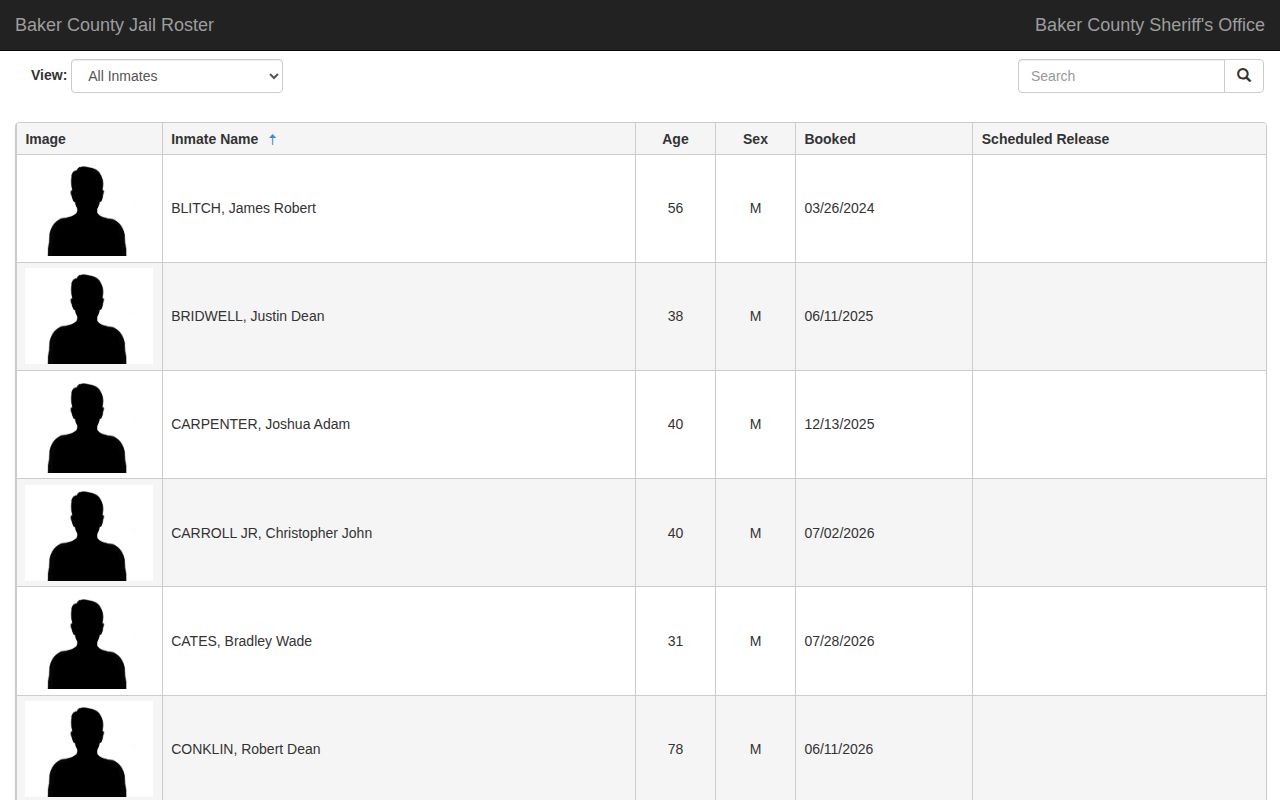
The screen can supply a docket or scheduled-date clue before a records inquiry, but it has no documented 72-hour history or former-record retention period.
A missing name still has several meanings. It may reflect community release, ODOC transfer, another jail, hospital movement, a court transport event, outside custody, or a correction. Record the time searched. Then ask the jail which event occurred instead of assigning a release label based on absence.
Note: Baker County publishes no official roster update cadence, so a refresh action should not be described as real-time synchronization.
Baker County Weekend Release Review
A three-day span may cross a weekend or holiday, but no Baker County source examined states a special release schedule, public exit time, staffing rule, or date-adjustment practice. Do not claim that a scheduled weekend date moves to Friday or Monday. The Baker roster's Scheduled Release field remains only a plan until the actual event is recorded.
Daily court calendars are also not release lists. Baker calendars show scheduled proceedings and can change. A hearing may be continued, a judge may issue an order, or another hold may remain. Even when a judgment credits time served, the jail must clear other legal bases and process the physical departure. The Baker court calendar is useful for locating a possible proceeding, while the filed register and judgment document the outcome.
For weekends and holidays, keep the same evidence chain: court record for legal disposition, jail event for physical departure, and receiving-system record for any transfer. The three-day range provides a practical search boundary. It does not relax the proof needed for each event.
Request Baker County Three-Day Records
Use the Baker Sheriff records process for existing jail records. A date-bounded request may ask: “Please provide any existing jail custody-status or release-event record for the period [start date and time] through [end date and time], including actual release date and time, release type or authority, destination or receiving agency, and hold or detainer disposition.” If seeking one person, add full name, date of birth, and booking number.
The public body need only provide responsive records it has. It does not have to create a new 72-hour list or answer a newly composed questionnaire. Narrow wording helps staff locate an existing event log, booking sheet, or custody history. The Sheriff form lists Jail Records at $10, or $15 when the record has ten or more pages. Fees are due before pickup by cash or check, and no guaranteed turnaround is published.
For a named person, add date of birth, booking number, booking range, and known docket. Ask for the booking sheet, custody-status history, release event, receiving agency, and holds. For a period-based inquiry, state that an existing log or report is sought if maintained. This distinction respects the rule that an office must produce existing responsive material but need not compile a custom list from separate files.
Written Oregon public-records requests generally receive acknowledgment or completion within five business days, subject to pauses and exceptions. Completion follows as soon as practicable, with a processing statement when the statutory timing requires one. Redactions can protect exempt material. Ask for the exemption citation and review route if part of the existing record is withheld.
Reconcile Baker County Release Days
Work through the range one event at a time. For each Baker jail departure, pair the custody event with the case docket. Bond, security, or recognizance means pretrial release under a court agreement, not dismissal or acquittal. Sentence or sanction served describes completion of the custodial part represented by the booking, but supervision or another case can remain. A transfer means custody continued elsewhere.
If ODOC or Powder River appears as the destination, use Oregon Offender Search and VISOR. Read institution, community supervision, release, and discharge as separate states. If a federal or immigration authority is specifically named, use that receiving system. No official evidence in the examined sources establishes Baker County Jail as a federal or ICE contract facility, so federal routes should be used only when the record identifies one.
| Record says | Three-day interpretation |
|---|---|
| Community release | Confirm actual time and any supervision that follows |
| Transfer to ODOC | County jail custody ended, but state custody continued |
| Court dismissal or acquittal | Case outcome only; check for other cases or holds |
| VISOR release alert | Reported change; verify type and time with the custodian |
| No online result | Search limitation, not proof of release or no history |
Keep the dates tied to their source. The court filing date, judgment date, scheduled release date, actual jail departure, VISOR alert time, and later discharge date can all differ. A sound three-day chronology lists each separately rather than choosing the earliest visible date. When two systems disagree, preserve both timestamps and ask the agency that created the underlying event.
For a specific person with older or uncertain history, the Baker County released inmate record path adds the durable court and agency-request routes. That process is safer than publishing a reconstructed three-day list from live data.